THE SOLAR CROWN
MINIATURE PAINTING COMPETITION
The Solar Crown, hosted annually at QuestCon, is Orlando’s premier miniature painting competition, designed to celebrate the talent, creativity, and technical excellence of painters across the tabletop hobby. Whether you're a seasoned artist or a passionate newcomer, this is your chance to showcase your work, connect with fellow painters, and compete for recognition and prizes.
SOLAR CROWN 2026 WAS AN amazing SUCCESS.
THANK YOU TO EVERYONE WHO PARTICIPATED, SEE YOU IN 2027!

WHAT’S CHANGING IN 2027?
2026’s success validated most of the format changes instituted since the first competition in 2025. Any changes to 2027’s format will be rolled out here over the next year, but I expect there will be relatively few. The only notable change at the moment is that Teen will collapse back into Youth only, a non-judged category for 17 and under.
The descriptions of the various merit tiers and their qualifications will be expanded and clarified to the benefit of both entrants and judges.
QUICK SUMMARY
Solar Crown runs on a hybrid open merit system. Every entry is judged against an objective standard and can earn a Bronze, Silver, or Gold Merit award based on its own quality.
We’ll still celebrate the top work, and these are the instances where entries will be compared to other entries:
Judges select Best of Category from the highest-merit pieces in each category.
From those category winners, judges award 3rd, 2nd, and 1st Best in Show.
Why the hybrid system?
Fairness & transparency: Your work is measured against a clear standard, not the luck of who else showed up.
More recognition: Excellent work across the board can be recognized - multiple Golds, Silvers, Bronzes (or none) are possible.
Better feedback signal: A merit level (Bronze/Silver/Gold) tells you where your piece stands relative to the standard.
Scales with growth: With more entries, open judging is faster while staying consistent.
How the system works (at a glance)
Merit Judging: Each piece is evaluated on five criteria, Technical Execution, Color & Composition, Creativity & Impact, Finishing & Presentation, Overall Impression, and awarded Bronze, Silver, or Gold based on its own merits.
Best of Category: Judges choose one Best of Category from the highest-merit entries in each category.
Best in Show: Judges rank the Best of Category winners to determine 3rd, 2nd, and 1st Best in Show.
Note: Youth (17 and under) entries are non-competitive - every Youth entrant receives a ribbon and a small prize.
What this means for you
Though some top slots exist, you’re largely aiming for a standard, more than competing for a slot.
If multiple entries meet Gold level, multiple Golds are awarded.
Even if a category is stacked, strong work still earns the recognition it deserves.
The very top work is still spotlighted through Best of Category and Best in Show.
Quick FAQ
Can a Silver win Best of Category?
If a category has no Golds, judges may select the top Silver as Best of Category.
I’m between the ages of 13 and 17, am I required to enter the Youth Category?
No, you may enter any of the main categories and compete against the full range of entries if you want.
Can I receive feedback on my entry?
Absolutely, you can receive feedback on your entry after the judging process is complete, or beforehand if you bring a miniature that is not part of the competition. Our judges are very happy to offer feedback, just please respect their time, they also need breaks sometime. As long as our judges are at the competition booth, feel free to approach and ask!
CATEGORIES
Youth (17 and under)
Definition: Non-competitive encouragement category for young painters.
Format: No judging. Every entry receives a ribbon and a small prize.
Notes:
Youth may display any subject.
Focus is on creativity and fun—bring your imagination!
Common Questions & Edge Cases
Q: How exactly do you measure?
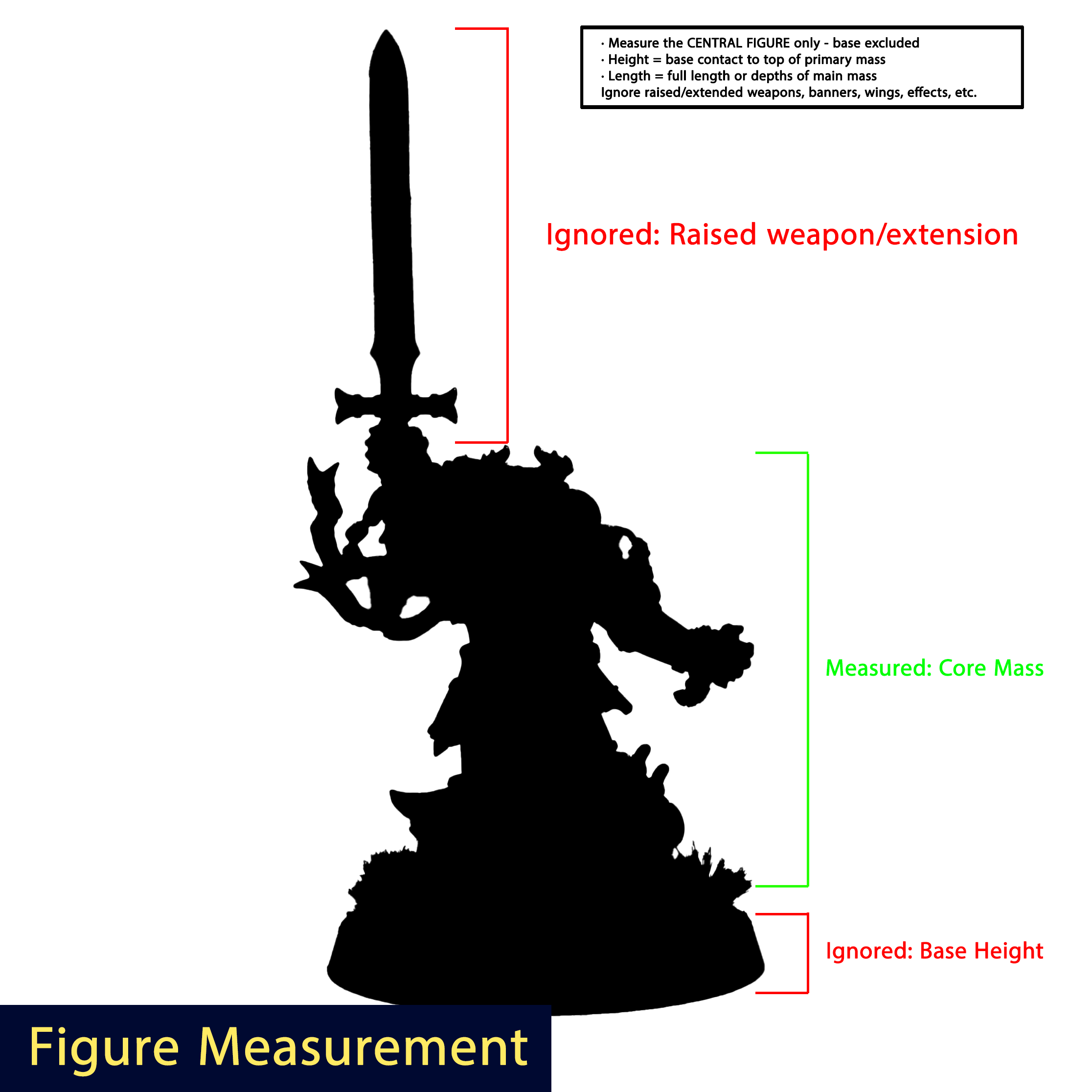
A: With calipers or ruler at check-in. We measure the core mass of the figure only (exclude base/plinth, and extensions that aren’t part of the figure’s core mass). Height = the highest point. Length = the longest horizontal extent.
Q: My model’s sword tip pushes it over 2", do I have to move to Mid-Size?
A: No, the sword is not part of the core mass of the miniature. See the diagram below on how we judge dimensions.
Q: I have a squad on individual bases arranged on a display board. Is that a Diorama?
A: Only if there’s a clear scene or interaction. If it’s a tidy display without narrative, enter an appropriate single (Small/Large/Vehicle) or ask staff how to best represent the work. We do not have a separate “Squad” Category.
Q: My “bust” includes abdomen/hips.
A: That’s fine, it still qualifies for the Bust category.
Q: Can judges move my entry to another category?
A: Yes, to ensure fair comparison if it’s an edge case that could qualify better for another category than the one stated at check in. You’ll be notified of any change.
Q: Conversions, 3D prints, scratch-builds?
A: All are welcome. Judging focuses on painting and presentation, not source or manufacturer.
Q: Multiple entries?
A: You may enter multiple categories; limit of one entry per category.
Quick Self-Check Before You Enter
Does my entry clearly fit the category by size/type?
If I claim Diorama, is there a narrative moment, not just a nice base?
If I claim Bust, is it truly a bust (head/shoulders/torso only)?
Am I entering Teen or Youth appropriately?
Solar Crown 2027 — Category Definitions
Small Figure
Definition: A single miniature 2" tall or under and 2" long or under (figure only; base/plinth doesn’t count).
Typical examples:
Human-sized infantry, small monsters or familiars
Gaming-scale characters (28-40mm)
Mounted models that still fit within 2" x 2" (measured on the figure, not the base)
Edge cases & notes:
Dynamic poses are measured at their highest/longest points (e.g., raised sword, outstretched wing).
If any dimension exceeds 2", the entry belongs in either Mid-Size or Large Figure.
MID-SIZE Figure
Definition: Any single non-vehicle model taller than 2" and/or longer than 2" (excluding base/plinth) but not exceeding 4” in either dimension.
Typical examples:
Champions, heroes, or monsters that are clearly larger than standard infantry but not centerpiece-scale, most 75mm scale human figures
Medium beasts/creatures (e.g., dire wolves, small drakes) that stay ≤ 4" in all dimensions
Riders on medium mounts that exceed 2" in at least one dimension but do not exceed 4"
Heavy armored suits or exo-frames larger than humans but under the 4" limit
Edge cases & notes:
If any dimension exceeds 4", enter Large Figure instead.
If both height and length are ≤ 2", enter Small Figure.
Non-organic vehicles or military ordnance (tanks, walkers, bikes, mechs, artillery) belong in Vehicle & Ordnance.
Busts are not Mid-Size; use the Bust category.
Large Figure
Definition: Any single non-vehicle model taller than 4" and/or longer than 4" (excluding base/plinth).
Typical examples:
True centerpieces whose height or length exceeds 4": giants, greater demons, adult/elder dragons
Massive creatures that break the 4" limit in any dimension: hydras, mammoths, tyrant lizards, titan-scale beasts
Mounted figures on very large beasts where the combined model exceeds 4" in height or length
Large constructs/golems or exo-frames (non-vehicle) that exceed 4"
Edge cases & notes:
If your subject is a non-organic vehicle or military ordnance (tank, walker, bike, mech, gunpla, artillery), enter Vehicle & Ordnance instead.
Busts are not Large Figures; use Bust category.
Vehicle & Ordnance
Definition: Standalone vehicles or artillery, with or without crew/riders.
Typical examples:
Tanks, APCs, walkers, mechs/gunpla, bikes, aircraft
Ballistae, cannons, siege engines, heavy weapon platforms
Edge cases & notes:
A single pilot/rider attached to a vehicle still counts as Vehicle.
Multiple vehicles with a scenic narrative may fit Diorama if storytelling is the focus; otherwise keep here.
Bust
Definition: A sculpt intended to represent the head/shoulders/torso (i.e., not a full-figure miniature).
Typical examples:
Display busts in any scale (1:10, 1:12, 1:16, etc.)
Shoulder/torso studies, character portraits
Monument Hobbies Texture Trainers
Diorama
Definition: A scenic entry with clear storytelling or interaction between elements (figures, environment, or both).
Must include at least one of:
Multiple figures interacting (duel, squad action, character moment)
A single figure within a narrative environment where the scene is integral to the story (not just a fancy base)
Environmental storytelling (terrain, props, effects) that communicates a specific moment
Typical examples:
Duel/vignette scenes
Multi-mini encounters with terrain and narrative focus
Scenic “slice” with lighting/effects that tell a story
Edge cases & notes:
A single model on an elaborate base is not automatically a diorama; the scene must carry narrative weight
How we measure size
Measurements exclude the base/plinth. We measure the tallest point and longest point of the painted figure itself.
Thresholds:
Small Figure: ≤ 2.00" tall and ≤ 2.00" long
Mid-Size Figure: >2.00" tall or > 2.00" long but ≤ 4.00" tall and ≤ 4.00" long
Large Figure: > 4.00" tall or > 4.00" long
If in doubt at check-in, staff may measure and help place your piece. Judges may reclassify to keep the field fair.
There is a maximum allowable footprint of 18” long or wide, and a max height of 24” for all entries, due to display space constraints. These measurements DO include the basing.
JUDGING RUBRIC
Merit Standards (Open Judging)
Not every entry receives a merit award. Entries are judged on painting and presentation only. Judging is style-neutral and manufacturer-neutral: no particular painting style or technique is favored.
Judges evaluate whether the painter’s choices are intentional, controlled, and successfully executed. Smoothness is not inherently superior to visible texture, painterly brushwork, stippling, weathering, or other approaches. Intentional texture or roughness should not be penalized simply for being unsmooth; uncontrolled or unintended texture may be.
No Merit Award does not mean that an entry is poorly painted or that the painter lacks skill. Solar Crown merit awards recognize specific competition-level standards. An entry may be complete, attractive, and successfully painted while still not meeting every requirement for a Bronze award.
How Merit TIER Judging Works
The judging process has two stages:
First, an entry must pass the Merit Eligibility Gate.
The Gate establishes the minimum level of preparation, completion, readability, and paint control required before an entry can be considered for an award.
Passing the Gate does not automatically earn Bronze.
Once an entry passes the Gate, judges determine whether it also meets the higher standards required for Bronze, Silver, or Gold.
A useful shorthand is:
Bronze = Strong Fundamentals
Silver = Refinement and Consistency
Gold = Mastery and Integration
An entry receives the highest tier for which it satisfies the complete standard.
Merit Eligibility Gate
All requirements must be met before an entry can receive any merit award. The Gate asks a simple question:
Is the entry complete, technically sound, and clearly readable enough to be considered for a merit award?
Preparation & Completion
No conspicuous mold lines, assembly gaps, exposed primer, or unfinished areas at 12–18".
Paint coverage and surface treatment appear intentional.
Base, plinth, or scenic presentation is complete and tidy.
Readable Value Structure
Major forms are distinguishable through light, midtone, and shadow.
The piece does not collapse into a single undifferentiated value range.
Forms remain readable at 12–18".
Intentional Paint Application
Highlights and shadows appear deliberately placed.
Color and material boundaries are generally controlled.
No major uncontrolled spillover, tide marks, patchiness, or other paint-application defects interfere with readability.
If any Gate requirement is not met, the entry receives No Merit.
Passing the Gate means the entry is eligible for merit consideration. It does not guarantee Bronze.
Bronze: Strong Fundamentals
Bronze recognizes an entry that takes the fundamentals beyond basic completion and readability. The painter demonstrates deliberate visual hierarchy, consistent control on the primary areas, and a coherent use of value, color, and presentation.
Readability & Visual Hierarchy
Primary forms read clearly at 12–18".
A discernible focal area or visual hierarchy is established.
Important elements are visually differentiated from secondary elements.
Technical Control
Paint application on primary surfaces is controlled and deliberate.
Value, color, and material transitions are deliberately handled.
Edges and material boundaries are generally clean where intended.
Minor inconsistencies may remain in secondary or difficult areas, but they do not interfere with the primary read.
Value Structure, Color & Contrast
Value range is sufficient to clearly describe the forms.
The piece avoids an overall “all midtone” appearance.
The palette is coherent and does not obscure readability.
Color and contrast reinforce readability and hierarchy.
Presentation & Integration
Base, plinth, or scenic presentation feels intentional rather than merely complete.
Presentation is visually coherent with the subject.
The entry has an overall sense of completion.
Allowable Flaws at Bronze
Examples may include:
Minor unintended texture on a surface intended to be smooth.
A few slightly uneven edges.
Small inconsistencies in transitions or secondary details.
A minor preparation blemish (gap, mold line, etc) visible only on close inspection.
Small areas that are less refined than the primary focal areas.
These flaws may be visible, but they should not undermine the overall read of the piece.
Dealbreakers for Bronze
Bronze cannot be awarded if:
Any Merit Eligibility Gate requirement is not met.
Value structure does not clearly separate major forms at 12–18".
No discernible focal area or visual hierarchy is established.
Control of transitions, edges, or material boundaries on primary areas is inconsistent enough to interfere with the intended forms.
Silver: Refinement & Consistency
Silver recognizes an entry in which the fundamentals are not merely strong, but refined and consistently applied throughout the piece. The painter demonstrates greater control, clearer hierarchy, and fewer distracting weaknesses across the entry as a whole.
Technical Refinement & Consistency
Surface treatment is consistently controlled across primary areas.
Value and color transitions are cleanly executed in a manner appropriate to the intended style.
Material boundaries are consistently well controlled.
Different materials remain visually distinct through deliberate use of value, color, texture, finish, or edge treatment.
No major visible area shows a noticeable drop in quality.
Silver should not contain obvious areas where execution drops noticeably below the quality of the rest of the piece.
Focal Hierarchy
Value and contrast deliberately guide the viewer’s eye.
The primary focal area reads clearly before secondary areas at 12–18".
Secondary areas support the focal hierarchy rather than competing unintentionally with it.
Lighting, contrast, and detail placement work together to establish visual order.
Color & Material Integration
Color choices reinforce the value structure and visual hierarchy.
Color variation remains deliberate and does not muddy readability.
Materials are clearly differentiated where appropriate.
Color relationships feel considered across the entire entry rather than resolved one area at a time.
Polish
Nothing significantly distracting is apparent at normal viewing distance.
Secondary and micro-details are cleanly resolved.
Surface finish, basing, and presentation are cohesive.
Close inspection reveals refinement rather than major inconsistencies.
Allowable Flaws at Silver
Examples may include:
A very small rough or uneven transition in a difficult recess.
A slightly soft or inconsistent edge visible only on close inspection.
A minor secondary detail that is less refined than the rest of the piece.
Very small imperfections that do not interfere with the focal hierarchy or overall presentation.
Dealbreakers for Silver
Silver cannot be awarded if:
Technical quality varies noticeably across similar materials or major surfaces.
The focal hierarchy is unclear or weakened by competing contrast.
Color or value choices flatten or obscure the primary focal area.
Secondary details contain execution problems that attract unwanted attention.
A preparation defect such as a mold line or assembly gap is visible on close inspection.
Gold - Exceptional Fundamentals, Clear Vision, High Polish
Gold recognizes mastery and integration. The entry demonstrates exceptional control without meaningful weak areas, and its technical, compositional, and presentational decisions work together as a unified artistic statement.
Exceptional Technical Control
Material, color, value, and surface transitions demonstrate exceptional control.
Edges are consistently handled according to their intended function: crisp, soft, broken, textured, or lost where appropriate.
Fine details are deliberate and clean.
Surface treatments remain convincing under close examination.
No major portion of the entry appears less resolved than the rest.
Gold does not require universally smooth blending. It requires that whatever surface treatment the painter has chosen be executed at an exceptional level.
Clarity & Visual Hierarchy
The entry has immediate readability at 12–18".
Visual hierarchy is clear and deliberate.
Light, value, color, edge treatment, and detail placement work together to move the eye intentionally through the piece.
Secondary focal areas support the primary read without competing unintentionally.
Close inspection reveals additional depth and refinement rather than weaknesses that were hidden at a distance.
Integrated Presentation
Color, value, material treatment, details, and base/plinth/environment function as a cohesive whole.
Presentation enhances the artistic intent of the entry.
Nothing feels incidental, unfinished, or disconnected from the overall visual concept.
The complete entry demonstrates a clear and confidently executed artistic vision.
Important
Gold does not require any particular named technique.
Non-metallic metal, object-source lighting, freehand, weathering, glazing, stippling, loaded-brush blending, airbrushing, texturing, or any other technique is neither required nor inherently rewarded.
A technique contributes to Gold only insofar as it is well executed and strengthens the piece.
Allowable Flaws at Gold
No flaws should be obvious at 12–18".
Extremely minor imperfections may be visible under close inspection provided they do not interrupt the visual read, technical consistency, or overall presentation.
Dealbreakers for Gold
Gold cannot be awarded if:
Any preparation flaw is readily visible on close inspection.
An uncontrolled transition, edge, or surface treatment noticeably interrupts the presentation.
Any significant section of the entry shows a meaningful drop in execution quality.
Color, value, or contrast choices confuse the intended focal hierarchy.
Base, plinth, or scenic presentation feels less resolved than the painted subject.
Strong individual elements do not resolve into a cohesive overall presentation.
BASIC RULES & REGISTRATION
ENTRY SUBMISSION
The competition booth at QuestCon Orlando 2026 will be open and accepting entries on Friday September 11 and Saturday Sept 12 from 10am to 5pm. Judging takes place Saturday night. Entries and any accompanying awards/prizes/merit coins may be picked up anytime on Sunday, but there will be an award ceremony at 3pm for Category and Special Award winners.
FEES?
There is no entry fee for the competition.
ORIGINAL WORK
All entries must be the original work of the competitor. You may not enter a piece that has been painted by someone else. Exception - parents/guardians may enter pieces in the Youth Categories for their children.
HOW MANY ENTRIES?
You may enter as many categories as you wish, but you may only enter one piece per category.
I’m between the ages of 13 and 17, am I required to enter the YOUTH Category?
No, you may enter any of the main categories and compete against the full range of entries if you want.
AWARD WINNING ENTRIES
You may enter a piece that has won other competitions, but you may not enter a piece that has previously won “Best in Show” or “Best Of” in a category, or a Gold Merit Award, in a prior Solar Crown competition.
PICK UP
All entries must be picked up by 5pm Sunday, the final day of the convention! If the deadline approaches, one effort will be made to contact you via any contact info listed on your registration form. Any pieces left past that time will be packed and taken home by the organizer, but we cannot be responsible for any damage to the piece that occurs during transport. If you wish to retrieve your piece afterwards, it will have to be shipped to you at your expense!
THANKS TO OUR 2026 JUDGES
social MEDIA
Contact Us
Questions about the competition? Interesting in sponsorship? Fill out the form, and we will get back to you as soon as possible!
THANK YOU TO OUR 2026 PRIZE SPONSORS